
策展人:
棉布
艺术家:
扬·鲍尔 /Jan Bauer
Jan Davidoff
石峻
王刚
吴京垿
柴中建
魏立刚
方二孟瑾
郭景涵
范祯
邹操
陈丹阳
王玉
邓英
崔强
夏洛特.爱神洛
吕美
金沙
吕鹏
Burkhard von Harder
沈奇
程兆星
Miguel Soler-Roig
王鹤
雎安奇
常智飞
Curator(s):
Mian Bu
Artist(s):
Jan Bauer
Jan Davidoff
Shi Jun
Wang Gang
Wu Jingxu
Chai Zhongjian
Wei Ligang
Fang Er & Meng Jin
Guo Jinghan
Fan Zhen
Zou Cao
Chen Danyang
Wang Yu
Deng Ying
Cui Qiang
Charlotte Eschenlohr
Lü Mei
Jin Sha
Lü Peng
Burkhard von Harder
Shen Qi
Cheng Zhaoxing
Miguel Soler‑Roig
Wang He
Ju Anqi
Chang Zhifei
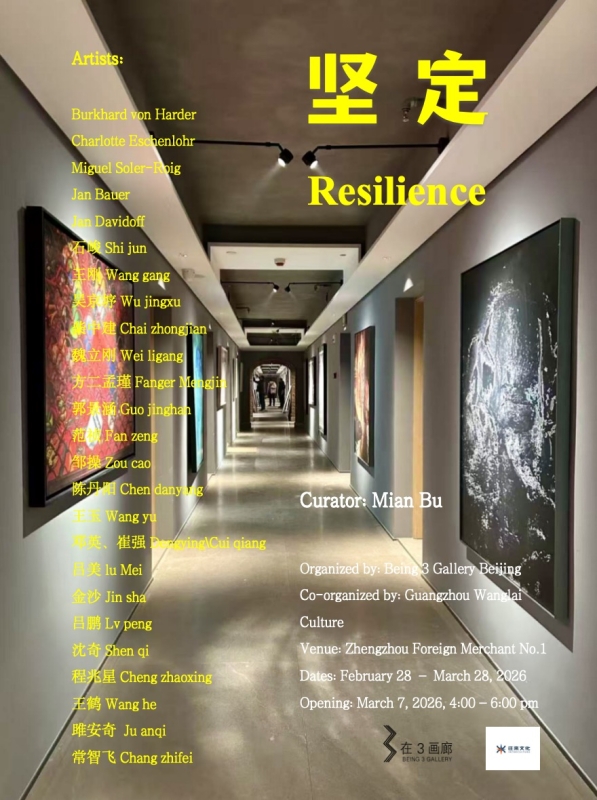
坚定——当代艺术群展 Resilience – Group Exhibition of Contemporary Art
在3画廊2026年首展:《坚定——当代艺术群展》
棉布
在3画廊2026年首展:《坚定——当代艺术群展》
策展人:棉布
艺术家:扬·鲍尔 /Jan Bauer ;Jan Davidoff ;
石峻;王刚;吴京垿;柴中建;魏立刚;方二孟瑾;郭景涵;范祯;邹操;陈丹阳
王玉;邓英、崔强;夏洛特.爱神洛/Charlotte Eschenlohr ;吕美;金沙;吕鹏
Burkhard von Harder ;沈奇;程兆星;Miguel Soler-Roig;王鹤;雎安奇 ;常智飞
主办:北京在3画廊
合作:广州往来文化
空间:郑州外商一号
导航地址:郑州外商公寓北二门
展期:2026年2月28日-3月28日
开幕式:2026年3月7日,下午:4:00-6:00
展览前言:
春节的灯笼已点亮郑州街巷,真漂亮。马年的钟声也即将敲响这座“中国铁路心脏”,我们欣然宣布:在全球格局动荡、经济下行的时代语境中,正式启幕筹备一整年的、大型当代国际艺术展览——《坚定》。
展览由郑州籍策展人棉布操刀,依托其丰富的画廊运营与国际策展经验,邀请国际顶尖艺术家与郑州本土知名的杰出艺术家群体,入展。既是策展人的精神归乡,亦是一场兼具学术性与在地性的豪华艺术汇报展。在此,我们热烈邀请每一位郑州父老乡亲,以“看艺术展过马年”的全新方式,亲近当代艺术,体悟其学术价值与文化意义,为郑州文化发展注入力量,为我们共同的文化记忆插入美术史的新页码。
这场名为《坚定》的大型展览的开幕式,就融入在每一天的乡亲们的看展中。热络中。乡音中。
春节的团圆不止于物质欢聚,马年的期许更在于精神的自省与提升。步入展厅,首先呈现的是邹操“绝代佳人系列”指纹绘画,其创作根植于当代观念绘画艺术流派,延续了约瑟夫·博伊斯“艺术即生活”的核心理念,以指尖为媒介,将身体印记转化为视觉语言。每一道独一无二的指纹肌理,既是手工创作对机械复制时代标准化生产的反叛,亦是对个体存在本质的学术追问,在美术史脉络中,呼应了抽象表现主义对情感与身体表达的追求,其美轮美奂的视觉呈现,实现了学术性与观赏性的统一,恰如马年“一马当先”的精神,彰显了当代艺术对个体表达的坚守。
摄影展区,德国艺术家布克哈德·冯·哈德的“抽象摄影”以及西班牙艺术家米格尔·索勒·罗伊格的“虚焦摄影”作品,隶属于当代杰出的两种摄影流派,承接了安德烈·柯特兹“模糊美学”的创作传统,通过主观化,以及虚焦处理,消解具象叙事,凸显色彩与形式的本体价值。布克哈德的《炼狱山三联画》以流动的色彩肌理,延续了抽象表现主义的色彩抒情性,同时融入极简主义的形式克制,打破了传统摄影“决定性瞬间”的审美范式,追问存在,向但丁的《神曲》致敬;米格尔·索勒·罗伊格的《花之梦》,则根植于新客观主义摄影脉络,以自然光为核心,定格日常物象的诗意本质,在写实基础上实现形式提纯,构建出兼具理性与诗意的视觉空间,彰显了当代摄影多元的学术走向。
泛政治化与象征绘画展区,集中呈现了当代艺术中“符号隐喻”的学术表达,延续了20世纪以来观念艺术与象征主义绘画的发展脉络。程兆星“红五星”系列,借鉴了德国新表现主义的视觉策略,将政治符号进行解构与重构,褪去单一符号意义,赋予其多元文化隐喻,在美术史层面,呼应了格哈德·里希特对符号与历史关系的探讨和学术回应;石峻《余下的仪式》以“管道”为核心符号,隶属于当代抽象象征主义流派,延续了马克·罗斯科“色彩即情感”的创作理念,以厚重的笔触与抽象肌理,隐喻生命韧性与生存困境,构成对“存在主义”哲学命题的视觉诠释,并向加斯顿致敬;吕美的“蓝塔”,红塔“系列,是心性象征的视觉表达,融合了东西方的美学特征;
作为艺术家柴中建,本人也是哲学家,请允许我们引用艺术家本人的自述:“‘世界3’。指世界是由“客观物质+主观表现+测量构造”这三重方式一体构成的——用一根木棍、一条线、一种标注线这种最简约的方式,显示了世界的本体与人类文化的状态。“一”隐示着“0与1”作为本体样态的存在;一根棍代表一切客观化存在的世界;一条线代表一切主观性表达都由一笔开始,都在一笔的笔笔之间;第三种线代表对客观物质显现与主观精神表达的测量累积与规划,一切人造物以及人工智能的发展都此而来的。
白底的画面一体浑然,三条线连贯一体。具有东方文化与哲学的意味。相比一下,黑色底上由三块独立的白色分别构成,意味着“分科”之学,是文化进入分科、科学化之后的西方文化特征。三个世界被分别发展就是现在人类的文化方式,所以命名为‘三个世界’。”这件作品,充满哲思,被称之为架上观念作品的典范。
本次展览的重要学术亮点,当属鲍尔“阿尔卑斯山系列”作品,其中聚焦多姆峰(Dom,海拔4546米)的画作,隶属于当代行动绘画流派,延续了杰克逊·波洛克“行动即创作”的艺术主张,艺术家将登山行动与绘画创作相结合,画面中标注的地点与线路,既是创作过程的真实记录,亦赋予作品“过程性”的学术价值,突破了传统绘画“静态呈现”的局限。多姆峰题材本身承载着“神圣性、浪漫主义崇高美学、登山精神”三重学术维度:“Dom”的语义内涵指向神性隐喻,山峰造型延续了19世纪浪漫主义绘画中“崇高美学”的视觉符号,单色调、穹顶轮廓与冰川肌理的运用,构建了“自然-文明”二元对话的经典母题,呼应了卡斯帕·大卫·弗里德里希对自然与精神关系的探讨。在现当代艺术脉络中,鲍尔将多姆峰穹顶形态抽象为“原始几何”,延续了贾科梅蒂、格哈德·里希特作品中“神圣性与自然力”的符号功能,填补了当代美术史中“阿尔卑斯山”题材的学术空白,成为该领域的重要研究样本。
展览的温情在表达,艺术绝非高高在上的学术奢侈品,而是兼具学术价值与精神滋养的“文化食粮”。在经济下行、精神需求愈发迫切的当下,这场展览既是当代艺术的学术呈现,亦是为市民打造的精神驿站。艺术作为一种心理治疗手段,正在被广泛应用于医院、社区和教育领域。人们广泛的感觉到,艺术家范桢的绘画作品,就有这种缓解压力、治疗心理疾病,等温柔的治愈感。
邓英《铁英街》《沙发》,郑州作为第二故乡的艺术家邓英,这些作品,简直是美好瞬间的浮世绘。她的作品风格被称为“甜甜圈日常派”,邓英的绘画回应着近500年以来,艺术史对女性艺术家日常生活题材的偏见和忽视。艺术家近20年的艺术实践,不仅将自己观察到日常叙事原本内含的愉悦,她内心的快乐和寓言形象作为风格化的绘画形式,还将其证明她的智慧,混合着童趣和非凡的心智。
几乎是20年前,生活工作于郑州,毕业于鲁美,央美的艺术家崔强,他的街景绘画系列,如《功夫》、《扇舞》、《公园》等,体现了表现主义的幽灵考古与尼采式酒神精神;同时,画面中,艺术家消解了表现主义的救赎叙事:武术姿态既非英雄主义也非存在主义绝望,而是德勒兹定义的“无器官身体”的纯乐。有些高更的遗产,但抛弃了其殖民主义视角,转而构建城市无产阶级的美学自治。画面中武术玩家的肢体延展为郑州地铁线路图,暗合德勒兹与加塔利的“根茎”理论:功夫不再是被博物馆化的民族遗产,而是渗透在城市化进程中的逃逸线路。
王鹤《抱抱——法老》,融合了波普艺术与童话美学的创作风格,延续了安迪·沃霍尔“通俗即艺术”的学术理念,以可爱化的视觉表达,打破了当代艺术“高冷化”的刻板印象,实现了学术性与通俗性的平衡。
自2025年以来,最被广泛提及应用的话题就是人工智能。绘画死亡论的幽灵复活(AI生成图像压迫下的肉身觉醒)——艺术与技术的融合。AI技术正在深刻改变艺术的创作方式,同时为艺术创作提供了新的空间和形式。艺术家在方二的作品“混沌宇宙”系列,机械性圆形被解构成震颤的电子脉冲——那些嵌套的同心圆既像射电望远镜捕获的宇宙微波背景辐射,又似老式唱片机跳针时划出的伤痕。美术史学家阿比·瓦尔堡(Aby Warburg)的“情念程式”在此显现:圆既是科技时代的图腾(硬盘碟片、粒子加速器轨道),亦是原始岩画中太阳轮的数字化转生。当荧光色圆弧在黑色背景中抽搐,便呼应着马格利特(René Magritte)对“物与名”的质疑。
艺术家郭景涵透过LED屏呈现数字艺术是非常具有环保概念,倡议大家能关注城市变迁,过程中与环境之间之间的一种平和关系。当作品被展示在灯箱上时,媒介的变化给观众带来了全然不同的视觉体验和深度感受。超大尺寸的展示让艺术家的作品在视觉上具有更强的冲击力和吸引力,观众可以沉浸在作品所营造的东方思想和先进科技带来的《大千世界》,感受到与之前不同的视觉冲击和触动。这种深度体验不仅仅是视觉上的,还包括心灵上的共鸣和情感上的触动。
他的灯箱作品《活着》,说出了存在本质,太惊心了。
艺术家孟瑾的绘画,一直处于空间和物的模糊性里,画面里有着形而上的气息。这次他带来了《静泉》系列,则以半抽象松弛的画面重构诗意的呼吸感——画面如单细胞生物般缓慢增殖,圆形不再是完满的象征,而是细胞膜般脆弱的时间容器。艺术家说,灵感来自德国诗人保罗.策兰的诗歌,恰好是美术史中的“残缺美学”(如断臂维纳斯)层面,是哲学的沉思。
非常知名的实验电影导演雎安奇,这次以他同样知名的绘画系列作品《草体》参展,雎安奇排除了画面中细碎的质感,仅保留冷硬的线条,暖色或冷色的氛围。他着迷于结构的稳定性,意识上的锋利,以及广袤易变的底色。十年来,他的画面内容一减再减,却有了恒常的时间感,饱满充盈的色彩,更趋于稳定的状态。“属于单色画流派。
巴黎艺术家王玉和慕尼黑艺术家夏洛特.爱神洛尔的绘画,带来了文化多样性和女性主义敏感优美,又富于反讽的幽默;而绘画考古与文化基因的架上突变(水墨与文艺复兴的血液相融)全球化与本土文化:新工笔顶尖艺术家群体金沙和吕鹏的艺术,在此做出了杰出的视觉表达,并早已取得非凡的成就,名声远扬。美国亚洲艺术委员会主席,新工笔研究专家,收藏家,史珏丽Julie Segraves女士无不y赞美的说:“这些杰出的艺术家在绢质的材质上运用中国传统水墨和色彩创作,展现了每位艺术家精湛的工笔绘画实践,并展示了他们对日常生活困境和当代社会面临的挑战的独特描绘。“
以大地为画布的、具有宇宙视野的杰出艺术家王刚教授,却带来了鲜见的天真童趣的绘画,本来,艺术家是纯洁的人。再或许,艺术注重的不是艺术形式本身,而是一种角度,一种温度,一种态度和一种力度;吴京垿教授,带来了纯视觉语言和材料运用的实验和探索之作。"X平方"是吴京垿一系列实验绘画中的三幅。他试图寻找或以个人的方式去究竟绘画中的空间多重性对于视觉、心理、以及生理的作用。提供了本次展览关于艺术的纯粹性的一面;最具抽象艺术的70后代表艺术家陈丹阳《巴赫平均律》系列,回应着绘画的本质是什么?正如同巴赫平均律音乐本身,陈丹阳绘画呈现了绘画最为纯粹的一面。我们也可以运用美术史中有效的工具“移情说”来感受绘画和音乐的通感。
亲爱的郑州父老乡亲,春节的脚步愈发临近,常设展的华丽灯光已点亮,一场兼具学术高度、国际视野与本土温度的艺术盛宴已然就绪。让我们携手以看艺术展的方式,过一个不一样的马年,我们的新年也将因这份“文化贡献”而更具学术价值与时代意义!
期待与您在《坚定》艺术展相遇,共贺马年新春,共赏艺术盛宴,过有意义的生活——墙上有一幅画!
致谢:
感谢中德广州往来文化机构创始人龚迎春博士。
感谢外商一号创始人武先生及其团队,20年来深耕折衷主义建筑空间创作,以本质化的空间设计,兼容多元艺术流派的表达,为本次展览提供了极具学术适配性的呈现载体。
Resilience – Group Exhibition of Contemporary Art
Mian Bu
Resilience – Group Exhibition of Contemporary Art
Curator: Mian Bu
Artists:
Jan Bauer, Jan Davidoff,
Shi Jun, Wang Gang, Wu Jingxu, Chai Zhongjian, Wei Ligang, Fang Er & Meng Jin, Guo Jinghan, Fan Zhen, Zou Cao, Chen Danyang,
Wang Yu, Deng Ying, Cui Qiang, Charlotte Eschenlohr, Lü Mei, Jin Sha, Lü Peng,
Burkhard von Harder, Shen Qi, Cheng Zhaoxing, Miguel Soler‑Roig, Wang He, Ju Anqi, Chang Zhifei
Organizer: Being 3 Gallery, Beijing
Cooperation: Wanglai Culture, Guangzhou
Venue: Foreign Merchants No.1, Zhengzhou
Navigation Address: North 2nd Gate, Foreign Merchants Apartment, Zhengzhou
Duration: February 28 – March 28, 2026
Opening: March 7, 2026, 16:00–18:00
Curatorial Essay
Spring Festival lanterns have brightened the streets of Zhengzhou, a splendid sight.
The chimes of the Year of the Horse are about to resound in this “heart of China’s railway network”.
It is with great pleasure that we announce the opening of FIRMNESS, a major international contemporary art exhibition one year in preparation, staged amid a global landscape of turbulence and economic downturn.
Curated by Zhengzhou‑born curator Mian Bu, drawing on her extensive experience in gallery management and international curation, the exhibition brings together leading international artists and prominent local artists from Zhengzhou.
It is at once the curator’s spiritual homecoming and a grand artistic showcase that balances academic rigor and local rootedness.
We warmly invite every resident of Zhengzhou to embrace contemporary art in a new way – celebrating the Year of the Horse with art – to appreciate its academic value and cultural significance, inject vitality into Zhengzhou’s cultural development, and add a new page to our shared cultural memory in the history of art.
The opening of this grand exhibition titled Resilience unfolds gently in the daily flow of visitors, in warm conversation, and in the sound of hometown dialects.
Reunion at Spring Festival is more than material gathering; the hopes of the Year of the Horse lie further in spiritual reflection and elevation.
Upon entering the exhibition, visitors are first greeted by Zou Cao’s fingerprint paintings from the Peerless Beauties series.
Rooted in contemporary conceptual painting, the works carry forward Joseph Beuys’s core idea that “art is life”, using fingertips as a medium to transform bodily traces into visual language.
Each unique fingerprint texture is both a rebellion against standardized production in the age of mechanical reproduction and an academic inquiry into the essence of individual existence.
Within the lineage of art history, they echo abstract expressionism’s pursuit of emotional and bodily expression.
Their stunning visual realization unites scholarship and aesthetics, embodying the Year of the Horse spirit of “taking the lead” and affirming contemporary art’s commitment to individual expression.
In the photography section, German artist Burkhard von Harder’s abstract photography and Spanish artist Miguel Soler‑Roig’s out‑of‑focus photography represent two distinguished contemporary photographic movements.
Inheriting André Kertész’s tradition of “aesthetics of blur”, they dissolve figurative narrative through subjectivity and soft focusing, emphasizing the ontological value of color and form.
Burkhard von Harder’s Mount Purgatory Triptych employs fluid color textures to continue the lyrical abstraction of abstract expressionism, while integrating the formal restraint of minimalism.
It breaks the aesthetic paradigm of the “decisive moment” in traditional photography, questions existence, and pays homage to Dante’s Divine Comedy.
Miguel Soler‑Roig’s Flower Dreams, rooted in the New Objectivity tradition, centers on natural light to capture the poetic essence of everyday objects.
Refining form on a realistic foundation, it constructs a visual space of rationality and poetry, revealing the diverse academic directions of contemporary photography.
The section of hyper‑political and symbolic painting presents the academic expression of “symbolic metaphor” in contemporary art, continuing the lineage of conceptual art and symbolic painting since the 20th century.
Cheng Zhaoxing’s Red Star series adopts visual strategies from German Neo‑Expressionism, deconstructing and reconstructing political symbols to strip them of singular meaning and endow them with plural cultural metaphors.
Art historically, it responds to Gerhard Richter’s exploration of the relationship between sign and history.
Shi Jun’s Remaining Rituals takes “pipes” as its core symbol, belonging to contemporary abstract symbolism.
Following Mark Rothko’s idea that “color is emotion”, the work uses thick brushstrokes and abstract textures to metaphorize resilience and existential struggle, offering a visual interpretation of existentialism and paying tribute to Philip Guston.
Lü Mei’s Blue Tower and Red Tower series are visual expressions of spiritual symbolism, merging aesthetic characteristics of East and West.
As both an artist and a philosopher, we would like to quote Chai Zhongjian’s own statement:
“World 3” refers to a world constituted by three integrated dimensions:
objective matter + subjective expression + measured construction.
Using a single stick, a line, and a marked line in their most minimal form, the work reveals the ontology of the world and the state of human culture.
The “One” implies the ontological existence of “0 and 1”;
one stick represents the world of all objectified existence;
one line represents that all subjective expression begins with a single stroke and unfolds stroke by stroke;
the third line represents the cumulative measurement and planning of the manifestation of objective matter and the expression of subjective spirit —
from which all man‑made objects and the development of artificial intelligence emerge.
The white‑ground painting forms an integrated whole, with three lines coherently connected, carrying Eastern cultural and philosophical connotations.
By contrast, the black ground composed of three separate white blocks signifies “disciplinary knowledge”, a characteristic of Western culture after its division into specialized sciences.
The separate development of the three worlds defines modern human culture, hence the title Three Worlds.
This deeply philosophical work is regarded as a model of conceptual painting on canvas.
A major academic highlight of the exhibition is Jan Bauer’s Alps series, especially his paintings of the Dom (4,546 m).
Belonging to contemporary action painting, they continue Jackson Pollock’s assertion that “action is creation”.
The artist integrates mountaineering with painting; the marked locations and routes on the canvas are both authentic records of the creative process and endow the work with the academic value of “processuality”, breaking the limitations of static presentation in traditional painting.
The Dom itself carries three academic dimensions: sacredness, the sublime aesthetics of Romanticism, and the spirit of mountaineering.
The semantic meaning of “Dom” points to divine metaphor; its mountain form continues the visual symbol of the “sublime” in 19th‑century Romantic painting.
Monochrome tones, dome contours, and glacial textures construct the classic motif of a “nature–civilization” dialogue, echoing Caspar David Friedrich’s exploration of nature and spirit.
Within modern and contemporary art, Bauer abstracts the Dom’s dome into “primal geometry”, continuing the symbolic function of “sacredness and natural force” in the work of Giacometti and Gerhard Richter.
It fills an academic gap in contemporary art history regarding the Alpine theme and serves as an important research example in this field.
The exhibition conveys a warm message:
art is by no means an elitist academic luxury, but “cultural nourishment” that offers both academic value and spiritual sustenance.
In a time of economic slowdown and growing spiritual demand, this exhibition is both an academic presentation of contemporary art and a spiritual station for the public.
As a form of psychotherapy, art is widely applied in hospitals, communities, and education.
Many viewers have experienced in Fan Zhen’s paintings a gentle sense of healing that relieves stress and soothes the mind.
Deng Ying’s Tieying Street and Sofa — created by an artist who regards Zhengzhou as her second home — are vivid ukiyo‑e of beautiful moments.
Her style is known as the “Donut Everyday School”.
Deng Ying’s practice responds to the prejudice and neglect of women artists’ daily‑life themes in art history over the past 500 years.
Through nearly 20 years of artistic exploration, she stylizes the inherent joy of everyday narratives, her inner happiness, and allegorical figures, demonstrating wisdom blended with childlikeness and extraordinary intelligence.
Almost two decades ago, Cui Qiang — an artist who lived and worked in Zhengzhou and graduated from the Lu Xun Academy of Fine Arts and the Central Academy of Fine Arts — created his streetscape series such as Kung Fu, Fan Dance, and Park.
They embody the spectral archaeology of Expressionism and the Nietzschean Dionysian spirit.
At the same time, the artist dissolves Expressionism’s redemptive narrative:
martial arts poses are neither heroic nor existentially despairing, but pure joy of the “body without organs” as defined by Deleuze.
Inheriting certain legacies of Gauguin yet rejecting his colonial perspective, Cui constructs an aesthetic autonomy of the urban proletariat.
The extended limbs of martial arts practitioners in his works resemble the map of Zhengzhou’s subway lines, resonating with Deleuze and Guattari’s theory of the “rhizome”:
kung fu is no longer a museumified national heritage, but lines of flight permeating the process of urbanization.
Wang He’s Hug – Pharaoh fuses Pop Art and fairy‑tale aesthetics, continuing Andy Warhol’s academic idea that “the popular is art”.
With endearing visual language, it breaks the stereotype of contemporary art as cold and aloof, balancing scholarship and accessibility.
Since 2025, one of the most widely discussed topics has been artificial intelligence.
The specter of “the death of painting” has returned — a bodily awakening under the pressure of AI‑generated imagery — alongside the integration of art and technology.
AI is profoundly transforming artistic creation while opening new spaces and forms for art.
In Fang Er’s Chaotic Cosmos series, mechanical circles are deconstructed into trembling electronic pulses.
Nested concentric rings resemble both cosmic microwave background radiation captured by radio telescopes and the scratches of a skipping record.
Aby Warburg’s concept of “Pathosformel” emerges here:
the circle is both a totem of the technological age (hard disks, particle accelerator rings) and a digital reincarnation of the sun wheel in primitive rock art.
As fluorescent arcs flicker against a black background, they echo René Magritte’s questioning of “thing and name”.
Guo Jinghan’s digital art presented on LED screens carries a strong environmental message, encouraging reflection on urban transformation and a harmonious relationship between progress and the environment.
When displayed in light boxes, the shift in medium delivers an entirely different visual experience and profound sensation.
Oversized presentation enhances visual impact and immersion, allowing viewers to enter the Boundless World shaped by Eastern thought and advanced technology, experiencing unprecedented visual and emotional resonance.
His light‑box work Alive articulates the very essence of existence, powerfully and startlingly.
Meng Jin’s paintings have long explored the ambiguity between space and object, imbued with a metaphysical atmosphere.
His new Quiet Spring series reconstructs a poetic sense of breathing through semi‑abstract, relaxed compositions.
Forms multiply slowly like unicellular organisms; the circle is no longer a symbol of perfection, but a fragile temporal container like a cell membrane.
The artist states that his inspiration comes from the poetry of Paul Celan, touching upon the “aesthetics of fragmentation” in art history — such as the Venus de Milo — and philosophical contemplation.
The renowned experimental film director Ju Anqi presents his celebrated painting series Cursive Script.
Ju eliminates delicate textures, retaining only sharp, cold lines and warm or cool atmospheric fields.
He is fascinated by structural stability, sharp consciousness, and vast, mutable backgrounds.
Over a decade, his compositions have been increasingly reduced, yet gained a constant sense of time, rich saturated color, and greater stability.
His work belongs to the monochrome painting movement.
Paintings by Paris‑based artist Wang Yu and Munich‑based artist Charlotte Eschenlohr bring cultural diversity and a feminist sensitivity, grace, and ironic humor.
The artistic mutations of painterly archaeology and cultural genes — the fusion of ink painting and the Renaissance spirit — as well as the dialogue between globalization and local culture, find outstanding visual expression in the work of leading new meticulous‑brush artists Jin Sha and Lü Peng, who have long achieved extraordinary acclaim.
Ms. Julie Segraves, Chair of the Asian Arts Council in the U.S., scholar, and collector of new meticulous painting, praised:
“These exceptional artists create on silk using traditional Chinese ink and color, demonstrating superb meticulous brushwork and offering unique depictions of the struggles of daily life and the challenges of contemporary society.”
Professor Wang Gang, an eminent artist with a cosmic vision who paints on the earth itself, presents surprisingly innocent and childlike works.
At heart, the true artist is pure.
Perhaps art values not form itself, but a perspective, a warmth, an attitude, and a force.
Professor Wu Jingxu displays experimental works exploring pure visual language and materiality.
X Squared consists of three paintings from a series of experiments in which he seeks to explore the psychological, visual, and physical effects of spatial multiplicity in painting, offering a dimension of artistic purity in the exhibition.
Chen Danyang, one of the most significant abstract artists of the post‑1970 generation, presents his Well‑Tempered Clavier series, posing the question: what is the essence of painting?
Like Bach’s Well‑Tempered Clavier, Chen Danyang’s work reveals painting in its most essential form.
We may experience the synesthesia between painting and music through the art‑historical tool of “empathy theory”.
Dear people of Zhengzhou,
Spring Festival draws near, and the splendid lights of the long‑term exhibition space are already lit.
An artistic feast of academic height, international vision, and local warmth is ready.
Let us celebrate the Year of the Horse together in a new way — through art.
Our new year will gain deeper academic value and contemporary significance through this cultural contribution.
We look forward to meeting you at Resilience
to celebrate the Year of the Horse,
to share this artistic feast,
and to live a meaningful life —
with a painting on the wall!
Acknowledgments
Special thanks to Dr. Gong Yingchun, founder of Wanglai Culture, Guangzhou.
Thanks to Mr. Wu, founder of Foreign Merchants No.1, and his team.
For 20 years, they have deeply engaged in the creation of eclectic architectural spaces.
With essentialist spatial design that accommodates diverse artistic movements, they have provided an exceptionally academically compatible venue for this exhibition.